The era of unconstrained artificial intelligence experimentation has officially come to a close.
According to Foundry’s 2026 State of the CIO report, 82% of CIOs are directly responsible for driving AI strategy and evaluating AI products, while 78% of IT leaders report that their departments are actively driving adoption across the enterprise. Yet, as executive suites demand hard financial outcomes, tech leaders face a startling reality: a massive gap has formed between pilot-phase hype and enterprise-wide value delivery.
Data across the enterprise analyst spectrum paints a stark picture:
- The ROI Bottleneck: According to Foundry's report, only 19% of IT leaders report that AI initiatives have met or exceeded business goals, while 18% admit fewer than a third of their use cases are hitting defined expectations. Across broader industry studies, PwC's Global CEO Survey revealed that 56% of CEOs have seen no significant financial benefit from AI, and MIT research indicates that approximately 95% of enterprise GenAI pilots fail to deliver measurable P&L impact or reach production.
- The Structural Hurdles: The primary roadblock facing tech leaders is an in-house skills shortage (40%), closely followed by ill-defined ROI metrics (32%) and murky corporate strategy alignment (31%).
- The Workflow Crisis: Leading enterprise researchers note that AI implementations are not stalling because of raw model capabilities. Instead, they are failing because organizations lack the structured workflows, connectivity, and governance needed to trust dynamic AI outputs in production.
As analysts across BCG and Forrester consistently point out alongside State of the CIO data, the organizations breaking through this AI plateau are not just buying better models. They are executing a comprehensive CIO AI strategy for 2026 by overhauling their control plane, governance frameworks, and security architectures.
The 3 structural shifts driving a winning CIO AI strategy in 2026
To transition from ad-hoc GenAI experiments to scalable, value-generating enterprise systems, forward-thinking CIOs and CTOs are executing three fundamental pivots:
1. From centralized CoEs to embedded AI squads and dual ownership
Centralized Centers of Excellence (CoEs) served as great incubators in 2024 and 2025, but they frequently created organizational bottlenecks. When every department submits requests without clear prioritization, central teams become clearinghouses where no single line of business takes true ownership.
Leading enterprises are replacing distant CoEs with embedded AI squads that operate directly inside business units. Crucially, projects now require joint accountability: a technical lead co-owning outcomes alongside a business-unit sponsor. If a line of business cannot attach a clear KPI (such as operational efficiency, customer resolution time, faster software commit cycles, or direct revenue lift) to an AI initiative, the project is not funded.
Historically, the adoption of AI and AI-assisted productivity tools has been heavily skewed toward technical practitioners, including developers, data scientists, and engineers. However, the next frontier of enterprise ROI depends on decentralizing this capability. True value emerges when you shift that orchestration power to the edge of the business, equipping non-technical business users with the right tools to design and drive outcomes themselves. The central mandate for 2026 is clear: empower, upskill, and elevate business domain experts to become AI super users.
This is exactly where Blunom accelerates the transition. By providing a no-code visual workflow builder, pre-built enterprise templates, and an extensible AI Marketplace, Blunom removes the traditional engineering friction from AI deployment. It allows business analysts, operations managers, and marketing leads to safely build, deploy, and govern their own agentic workflows. By equipping business users to act autonomously within a secure, layered framework, enterprises ensure that the people closest to the business problem are the ones actively driving the AI solution.
2. Moving up the maturity curve: the rise of agentic workflows
Simple retrieval-augmented generation (RAG) and isolated chatbots provided incremental productivity, but they rarely moved the needle on macro bottom-line metrics. Analysts at Forrester and BCG note that the industry is rapidly shifting toward Agentic AI: autonomous systems capable of executing multi-step, complex workflows.
In fact, 70% of CIOs report accelerating investments in agentic systems over the coming year. Recent BCG benchmark data reveals that 35% of enterprise tech leaders target a 3:1 or better ROI within 1 to 2 years as they shift from pilots to agentic transformation, with 87% engaging specialized ecosystem partners during the proof-of-concept phase. However, handing operational control to dynamic AI agents introduces new architectural risks: model drift, non-deterministic decision pathways, data leakage, and compliance vulnerabilities.
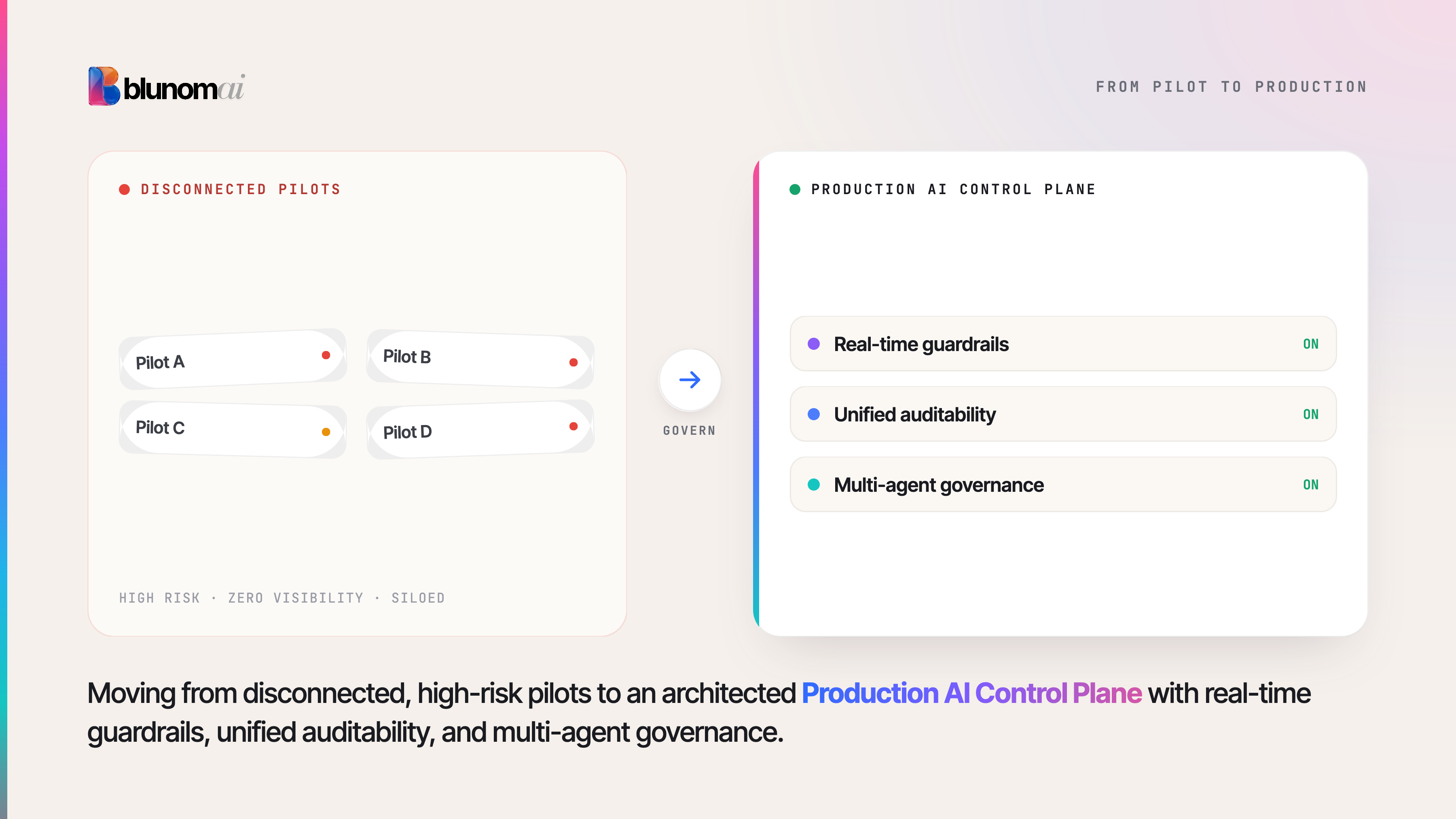
Figure 1: Moving from disconnected, high-risk pilots to an architected Production AI Control Plane with real-time guardrails, unified auditability, and multi-agent governance.
3. Implementing a dedicated AI security and control plane
According to BCG and Forrester enterprise research, the top barrier preventing full production deployment of AI is not model capability. It is trust, risk, and security.
Third-party economic studies highlight the potential returns of production maturity. For example, in Forrester's Total Economic Impact™ (TEI) study examining generative AI deployments on AWS, composite enterprises achieved a 240% ROI with a payback period under 6 months. While these illustrative third-party benchmarks reflect specific infrastructure investments rather than universal performance guarantees, they demonstrate the massive financial upside of reaching production maturity.
As 53% of enterprises establish formal AI approval processes, organizations moving from human-in-the-loop chatbots to multi-agent ecosystem orchestrations realize that securing the data flow is paramount. Enterprise leaders can no longer rely on legacy network security tools to monitor non-deterministic prompt inputs, dynamic data retrieval, or autonomous API executions. Achieving true ROI requires a structured Control Plane that intercepts, validates, and governs model interactions before they touch enterprise data.
Equally critical to security is the financial governance of these dynamic systems. Unbounded API costs and untracked token usage can quickly erode the very ROI these initiatives are meant to deliver. Organizations require precise cost controls, commonly known as TokenOps, to tie LLM expenses directly back to specific cost centers and outcome-based activities. True enterprise scale requires 100% visibility and attribution across every single user, workflow, and autonomous agent in the ecosystem.
This is where Blunom delivers a critical financial and operational advantage. Within the Blunom Secure AI Control Plane, our dedicated TokenOps engine enforces granular budget limits and cost caps across all teams and models. It provides comprehensive attribution for every API execution, allowing finance and IT leaders to track exactly which agents and business units are driving costs. Furthermore, Blunom goes beyond simple reporting by providing continuous recommendations on cost efficiency improvements, ensuring that your enterprise consistently achieves the best price and performance ratio for your token utilization.
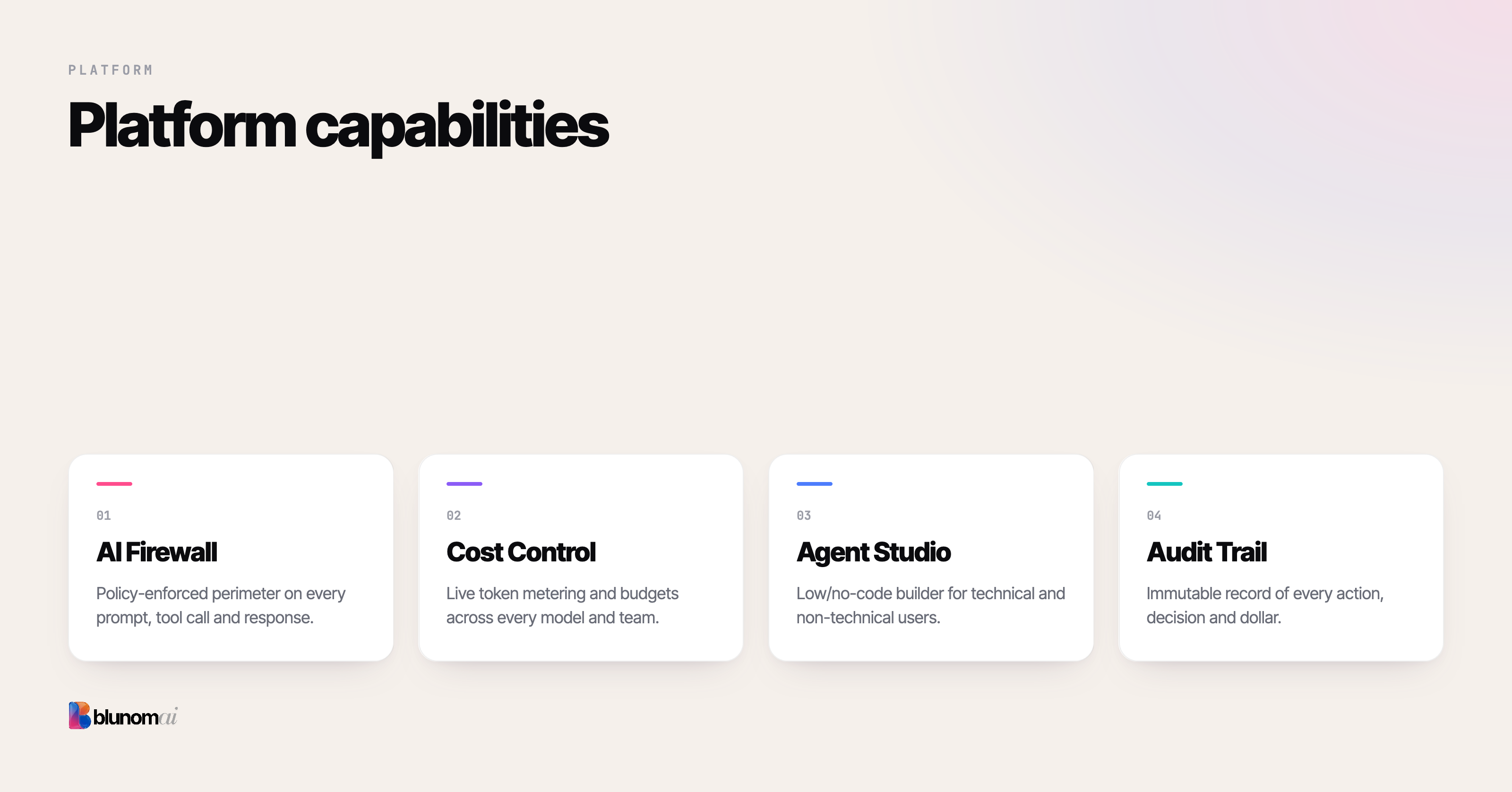
Figure 2: Blunom platform capabilities spanning AI Firewall, cost control, Agent Studio, and an immutable audit trail.
How Blunom operationalizes enterprise AI governance and scale
At Blunom, we built our enterprise platform specifically to solve the structural, operational, and security roadblocks that cause the vast majority of AI initiatives to fall short of ROI expectations.
Rather than locking enterprises into a single foundation model, Blunom provides a model-agnostic architecture. This enables IT leaders to easily switch models to hedge against pricing shifts, avoid vendor lock-in, and match specific models to optimal tasks based on cost, context window, and latency requirements.
To support a complete CIO AI Strategy for 2026, the Blunom 7-Layer Secure AI Control Plane bridges the gap between executive vision and enterprise-grade execution. By integrating a dedicated Security Layer at #2, positioned at the base of the stack, we ensure strict data governance before information moves upstream. The complete integrated stack includes:
- Model-Agnostic Abstraction: The foundational layer enabling seamless switching between LLM providers to ensure performance and cost optimization.
- Dedicated Security Layer: Enforces per-organization envelope encryption and Row-Level Security (RLS) multi-tenant isolation before data moves upstream.
- Content Guardrails & Policy Engine: Real-time inspection of prompts, tool calls, and retrieved context to aggressively reduce data-leakage risk.
- TokenOps & Budget Governance: Enforces granular token usage limits, cost caps, and departmental budget policies to eliminate runaway API bills.
- Enterprise Integration Connectors: 42+ native connectors across cloud providers, business applications, and dev platforms with secure server-side credential resolution.
- Agent Orchestration & Workflow Builder: A no-code visual builder and pre-built templates that empower embedded squads to build agents, directly overcoming the 40% skills gap.
- Multi-Agent Delegation & Approval Gates: Enforces explicit delegation bounds (depth limits, nested traces) and deny-by-default human-in-the-loop authorization for sensitive mutations at the execution layer.
How Blunom maps to the 3 structural shifts
| Structural Shift | Enterprise Challenge | How Blunom Solves It |
|---|---|---|
| 1. Embedded Squads & Dual Ownership | Skills shortages (40%) and lack of business unit ownership. | No-Code AI Builder & RBAC: Empowers business users to create agents, AI workflows, and AI Apps, while resource-level RBAC enforces team scoping. |
| 2. Agentic Workflows | Non-deterministic risks, model drift, and agent sprawl. | Bounded Delegation & Approval Gates: Restricts agent depth, enforces human sign-off on destructive actions, and tracks full execution traces. Connect to over 100+ business applications. |
| 3. Security & Control Plane | Data leakage risks, unmonitored APIs, and runaway costs. | Layered Security & TokenOps: Enforces encryption, RLS multi-tenant isolation, content policy filters, and strict cost caps. |
Executive summary and next steps
The moat in 2026 enterprise tech is no longer access to the base model. It is the operational discipline, security framework, and governance architecture built around it.
CIOs who master the dual role of operating architect and risk officer will lead the next decade of digital transformation. By establishing joint accountability, shifting toward agentic workflows, and deploying a robust control plane like Blunom, enterprise leaders can close the gap between AI hype and sustainable financial returns.
Ready to move beyond disconnected AI pilots?
- Request access to discuss enterprise deployment
- Attend a free interactive training session in our dedicated workshop environment at BluLab
- Explore the platform or schedule an executive demo to evaluate your organization's AI maturity
Trevor Hansen, Founder and CEO at Blunom Inc.