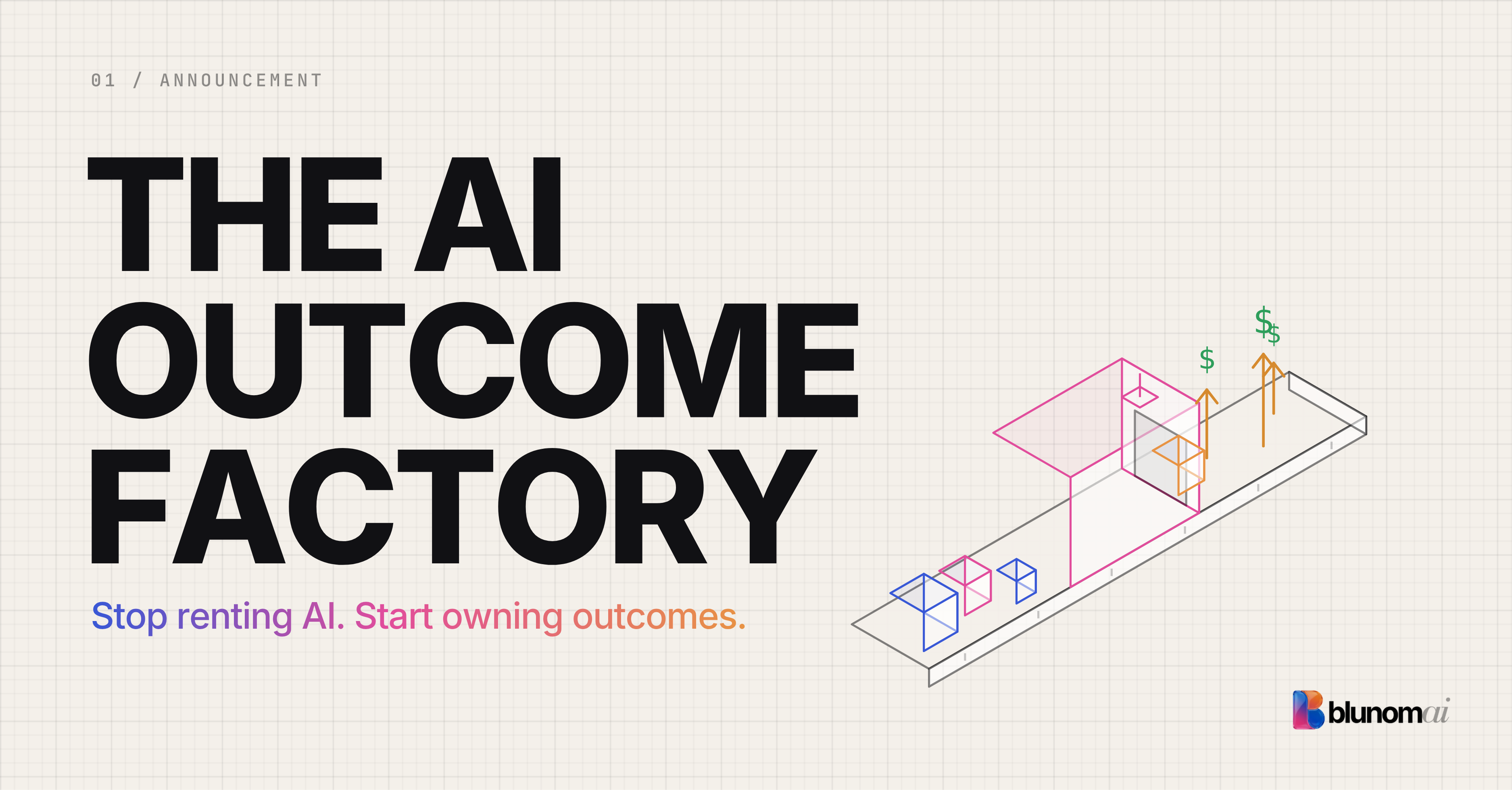
An AI Outcome Factory is a repeatable system for delivering working, governed AI outcomes to a business. It combines sovereign technology you own, a proven delivery process, and upskilling that transfers ownership to your people. Instead of buying licenses and hoping for results, you commission outcomes and keep the factory.
Most enterprises don't have an AI problem. They have an AI outcome problem.
The pilots ran. The demos impressed. And somewhere between the proof of concept and the P&L, it all stalled: costs nobody predicted, agents nobody governs, and a vendor invoice that grows whether or not the business does.
At Blunom, we enable customers to build, govern, and run AI agents anywhere: your cloud, your VPC, your data center. The AI Outcome Factory is how we put that capability to work. We built it to end the pilot-purgatory pattern for good. Here's what it is, how it runs, and why it's different from everything else with "AI factory" in the name.
Isn't an "AI factory" just GPUs and data centers?
That's the common definition, and it's exactly what we're not talking about. A traditional AI factory industrializes model production: chips, clusters, and training pipelines that turn data into models. An AI Outcome Factory industrializes something scarcer: turning AI capability into measurable business results, from revenue to cost savings to hours returned.
| Traditional AI Factory | AI Outcome Factory | |
|---|---|---|
| Output | Trained models, inference capacity | Working, governed business outcomes |
| Measured in | FLOPS, tokens, throughput | Revenue, validated savings, adoption |
| Built by | Infrastructure vendors | You, with a partner ecosystem |
| You own | A bill | The platform, the agents, the skills |
Models are an ingredient. Outcomes are the product.
What comes off the line?
Production agents that do real work inside your perimeter. Think order-status agents that live inside your ERP data, invoice-matching workflows that clear exceptions overnight, or a customer-operations copilot your frontline team actually uses. Each one is governed, cost-capped, and auditable from day one.
Every outcome ships on three assembly lines running together: Technology. Process. People. Miss one, and you're back in pilot purgatory.
Line 1: Technology, a sovereign platform you own
The factory floor is the sovereign AI control plane: a seven-layer stack where you build, govern, and run AI agents in one place, deployed anywhere you choose. Your cloud, your VPC, or your own data center. You own the infrastructure. We make it run.
That means:
- AI Firewall: policy enforced on the agent execution path, not bolted on after
- TokenOps: budgets, model routing, and stop conditions so no agent ever spends its own ROI
- Orchestration: 350+ models, your data connectors, and your apps in one governed system
- No per-seat licenses. No black box. A fraction of the cost of enterprise SaaS. And when the engagement ends, the platform stays yours.
Sovereignty isn't a compliance checkbox here. It's the ownership model.
Line 2: Process, from workshop to production on rails
Every outcome follows the same three-stage path. No improvising, no eighteen-month roadmaps.
Stage 1: Executive Workshop. We start with your business, not our demo: a transformation interview to surface your biggest challenge and opportunity, then three candidate use cases scored on cost, value, and risk. One condition matters more than any agenda item: the right people in the room. These are P&L-impacting discussions across every line of business, not just technology, so we ask for the leaders who own those numbers. Sales, operations, finance, and IT, at the level that can commit. You leave with a ranked plan, not a pitch.
Stage 2: Proof of Concept. Forward-deployed engineers build the top use case on the platform: data preparation, implementation, deployment, and integration, with success metrics defined before work begins. You watch it happen in Agent Studio, not in a status deck.
Stage 3: Production. The POC hardens into a managed, monitored, governed workload, with training, evaluation, and support built in. Then the factory runs the next use case. And the next.
Delivery is partner-led by design: the system integrators and MSPs who already know your environment run the line with us, evolving into Managed Intelligence Providers along the way.
Line 3: People, so ownership transfers with the technology
The most expensive AI failure mode is the one nobody budgets for: a working system nobody in-house can run.
So the factory upskills your team while it builds:
- BluLab: role-based, hands-on workshops where your business and technical teams build real agents in an isolated sandbox and earn Blunom AI Certification
- Enablement: playbooks and workflows for each function, not a PDF nobody opens
- Measured adoption: usage tracked, change sustained, admins in control of cost and access
By the time an outcome hits production, the people who'll run it already have.
How do you measure an AI outcome?
An AI outcome is measured the way the business already measures itself: verified net-new revenue, validated cost savings, or hours returned to the team, with agent-level cost tracked against each result. If the number can't survive a CFO's review, it isn't an outcome yet.
Our commercial model puts our fee where that math is: a predictable platform fee plus a success fee tied to verified results. No outcome, no success fee.
Own the factory, not the subscription
The old model: rent intelligence by the seat, forever, from a vendor who owns your roadmap.
The factory model: commission outcomes, govern everything, upskill your people, and own the machine that made it all.
Ready to see your first outcome on the line? Request access or book a BluLab workshop and put your team on the factory floor.
FAQ
What is an AI Outcome Factory?
An AI Outcome Factory is a repeatable system for delivering working, governed AI outcomes to a business. Built on a platform to build, govern, and run AI agents anywhere, it combines sovereign technology in your environment, a staged delivery process from workshop to production, and upskilling that transfers ownership to your people.
How is an AI Outcome Factory different from an AI factory?
A traditional AI factory is infrastructure for producing models: GPUs, data pipelines, and training capacity. An AI Outcome Factory produces business results: governed production agents measured in revenue, validated savings, and adoption, built on a platform the enterprise owns.
What does the AI Outcome Factory process look like?
Three stages. An executive workshop brings P&L owners from every line of business together to identify and score three use cases on cost, value, and risk. A proof of concept builds the top use case with success metrics defined up front. Production hardens it into a managed, governed workload.
Who delivers the AI Outcome Factory?
Blunom runs the factory with delivery partners: system integrators and managed service providers who build, deploy, and manage outcomes on the platform with forward-deployed engineering support, evolving into Managed Intelligence Providers as their agentic AI practice grows.
Do we own the platform when the engagement ends?
Yes. The platform deploys in your cloud, private VPC, or data center with no per-seat licensing. Your team is trained and certified through BluLab as outcomes are built, so ownership transfers with the technology, not after it.
Does the AI Outcome Factory work with the AWS BOX Program?
Yes. For organizations in the AWS Business Outcomes Accelerator (BOX) Program, we can run the AI Outcome Factory as a Vertical BOX Campaign: targeting AI Outcome delivery for a specific vertical, with use cases, delivery partners, and success metrics aligned to that industry from the workshop stage forward.
Serge Shevchenko, Co-Founder at Blunom Inc. | serge@blunom.ai