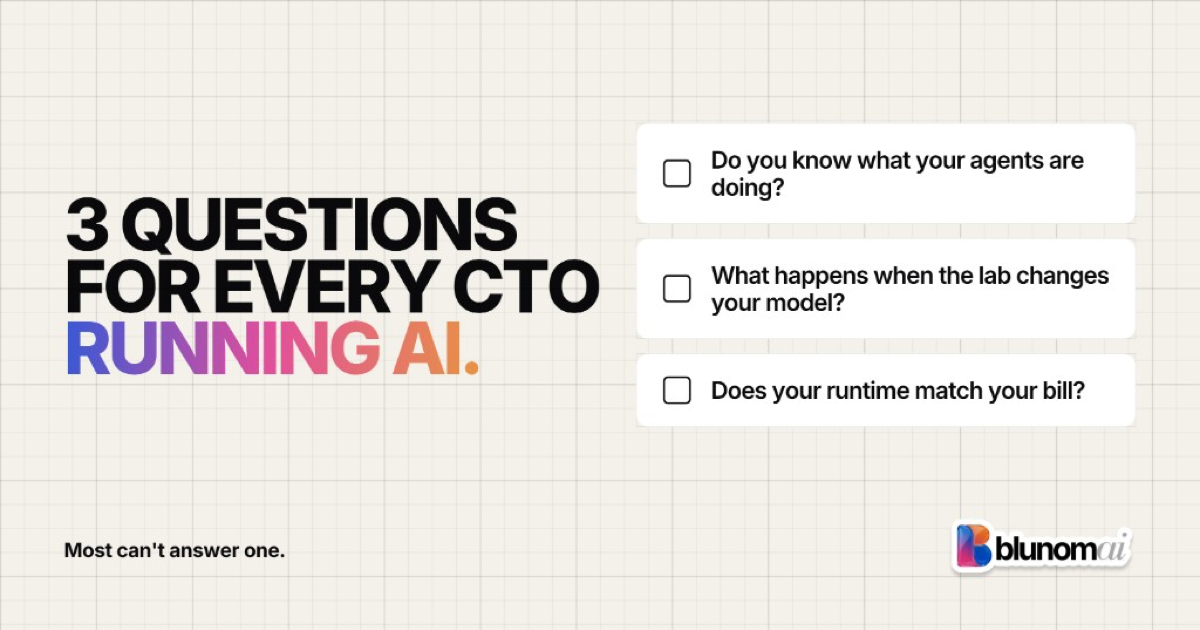
Every CTO running AI in production should be able to answer three questions: what are my agents and applications doing right now, what happens when a frontier lab changes the model underneath them, and does my runtime actually match my bill? Most can't answer even one. That gap is where outages, silent regressions, and cost spikes live.
Here's how most companies got here, and nobody did anything wrong.
Two years ago, teams started shipping AI features. Each team picked a model, wired it in, and moved on. It worked, so more teams did it. Then agents arrived: systems that reason, call tools, and retry on their own. Today the average enterprise runs dozens of AI applications and agents, built by different teams, on different models, with different logging, different keys, and no shared layer underneath any of it.
Each piece made sense when it shipped. The sum is a stack the CTO owns but cannot see.
Three questions expose the problem. Ask them of your own organization.
Question 1: Do you know what all your agents and applications are doing right now?
Not what they were designed to do. What they are doing, right now, in production.
Which agents exist, including the ones business units built without telling you. Which tools and APIs each one can call. Which data each one touched today. Which prompts went in and which actions came out. Whether any of them are looping, retrying, or being steered by content they ingested.
For most organizations the honest answer is no. Logging is per-team and inconsistent. There is no inventory of agents, let alone shadow agents. And when something goes wrong, reconstruction means grepping five logging systems owned by five teams.
Traditional software earned observability decades ago. Agents make decisions at runtime that nobody scripted, which means they need it more, and mostly have it less.
Question 2: Are your applications hardcoded to a specific model? What happens when the lab changes it?
Frontier labs update models constantly. Versions get deprecated. Behavior shifts inside the same model name. Pricing changes. And your applications, hardcoded to a specific model at build time, inherit every one of those changes silently.
So ask the follow-up: are you running benchmarks? Do you have evals for your own tasks, on your own data, that would even detect a regression when a model changes underneath you? If the lab swaps the model behind the API next Tuesday, would you find out from your evals, or from your customers?
For most teams the eval suite does not exist. Quality is measured by vibes and support tickets. And switching models to escape a regression, or to capture a better price, means an engineering project per application, because the model was welded in.
The model layer is the least stable part of your stack. It changes on someone else's schedule. Building directly against it, with no abstraction and no measurement, is a dependency choice no CTO would accept anywhere else in the architecture.
Question 3: Do you know exactly what your AI runtime costs? Because the bill may not.
This one comes from our own telemetry, and it surprises people.
Across deployments, we have noticed that the frontier labs' billing does not always match what we observe at runtime. The invoice says one thing. The actual runtime activity says another. Sometimes the gap is timing. Sometimes it is retries and context growth the meter counts differently than you assumed. Sometimes nobody can explain it, because there is only one meter, and the lab owns it.
Now add agents. A looping agent that retries, pulls growing context, and fans out tool calls can multiply spend in an afternoon. If your only view of cost is the provider's invoice at the end of the month, you can have a crazy cost spike running right now and not even know it's happening. You find out in thirty days, with no per-agent breakdown, no way to attribute it, and no way to prove the meter is right.
No CTO would run cloud infrastructure on a bill they cannot reconcile. AI runtime deserves the same discipline: your own meter, at your own runtime, on every call.
The painkiller: own the layer these questions live in
All three questions have the same root cause. The visibility, the model flexibility, and the metering all belong to a layer nobody built, because every team was busy shipping features. That layer is exactly what Blunom is.
Blunom is the Sovereign AI OS: build, govern, and run AI agents, apps, and workflows in your environment, on one platform that business and technical teams share. For a CTO, it answers the three questions directly:
What are my agents doing? Every prompt, tool call, and response flows through one governed runtime with full observability and an AI Firewall enforcing policy on the execution path. One inventory. One audit trail. Including the agents business units build themselves, because they build them on the same platform.
What happens when the model changes? Nothing you didn't choose. Applications connect to Blunom, not to a lab. You control model routing per API, per agent, and per application, across a catalog of 400+ models, and you own the evals that define what "good" means for your tasks. When a lab changes a model, your benchmarks catch it and your routing adapts. No rebuild.
What does runtime actually cost? TokenOps meters every call at your runtime, so you hold an independent record to reconcile against any provider's invoice. Budgets apply per user, department, client, and agent. Stop conditions kill runaway loops in the moment, not on next month's bill.
Developers connect through a drop-in API and keep their frameworks. Business teams build in Agent Studio. And all of it deploys in your environment, on AWS, so the layer that watches everything is a layer you own.
You cannot manage a stack you cannot see, cannot measure quality you never defined, and cannot control spend on a meter you don't hold. Fix the layer, and all three questions become dashboards.
Ask the three questions internally this week. If any answer is no, reach out or explore Blunom in AWS Marketplace. We'll show you your own stack from the layer you've been missing.
FAQ
What visibility should a CTO have into AI agents in production?
A complete inventory of every agent and AI application, the tools and data each can access, and a full runtime audit trail of prompts, tool calls, and actions. Because agents make unscripted decisions at runtime, they require deeper observability than traditional software, enforced where they execute.
What happens when a frontier lab changes a model my applications use?
Behavior, quality, and cost can all shift silently, since labs update and deprecate models on their own schedule. Without task-specific evals, regressions surface through customers instead of benchmarks. Model-agnostic routing with owned evals lets teams detect changes and switch models without rebuilding applications.
Why doesn't my AI provider's bill match my actual usage?
Provider invoices reflect the provider's meter, and retries, context growth, agent loops, and billing timing can make invoiced spend diverge from observed runtime activity. Independent metering at your own runtime creates a per-call record you can reconcile against any invoice and attribute to specific agents and teams.
How does Blunom help CTOs control AI cost spikes?
Blunom meters every model call at runtime through TokenOps, enforces budgets per user, department, client, and agent, and applies stop conditions that halt runaway loops immediately. Cost control happens on the execution path in real time, not on an invoice thirty days later.
Serge Shevchenko, Co-Founder at Blunom Inc. | serge@blunom.ai