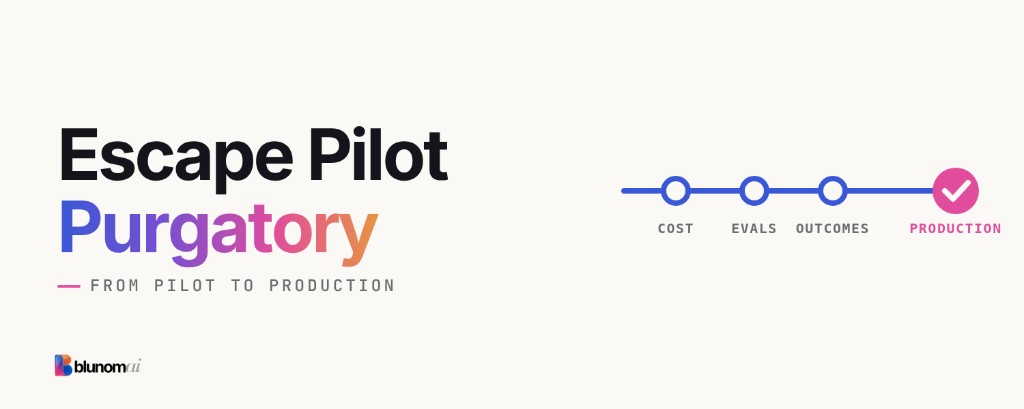
Most agentic AI pilots fail to reach production for three reasons: no cost governance, no evaluation discipline, and no owner for the business outcome. The demo works. The operating model does not exist. This post covers what separates the enterprises scaling agents in 2026 from the ones stuck in perpetual pilot purgatory.
The gap between adoption and production
The adoption curve is vertical. Gartner predicts 40% of enterprise applications will embed AI agents by the end of 2026, up from less than 5% in 2025, and the agentic AI market is projected to grow from roughly $8 billion to over $52 billion by 2030. Meanwhile only 12% of enterprises report mature AI governance processes. Adoption is moving at one speed, governance at another, and the gap between them is where pilots go to die.
Practitioners have a name for the failure state: perpetual pilot purgatory. The pattern is always the same. A team builds an impressive agent in three weeks. Leadership loves the demo. Then it sits in staging for nine months because nobody can answer three questions: What will it cost at scale? How do we know it still works next month? Who owns the outcome?
Those are not technology questions. Every one of them is an operating model question. Which is why buying more pilots never fixes it.
Question 1: What will it cost at scale?
Agent economics are unlike anything enterprise IT has priced before. A chatbot answers a question and stops. An agent loops. It reasons, calls tools, reads results, and reasons again, consuming tokens on every iteration. A workflow that costs $0.40 per run in the demo can cost $4.00 in production when real-world inputs trigger longer loops, retries, and tool failures. Multiply by 50,000 runs a month and the CFO discovers the problem at invoice time.
Industry research on 2026 deployments flags cost governance as a first-order requirement precisely because runaway spend in large-scale agent deployments killed budgets across the first generation of pilots. Vendors market narrow agentic token control modules; enterprises need broader AI agent cost controls enforced at the agent runtime, not just on the monthly bill. The discipline emerging in response is best described as TokenOps: treating token consumption the way FinOps treated cloud spend.
TokenOps in practice means four controls:
Attribution. Every token attributed to an agent, a workflow, a customer, and a business outcome. "The AI bill went up" is not a finding. "Invoice-processing agent unit cost rose 30% after the model swap" is.
Budgets and guardrails. Hard caps per agent and per workflow, enforced at runtime. An agent that hits its loop budget stops and escalates. It does not quietly burn $800 overnight.
Routing economics. Most agent steps do not need a frontier model. Route classification and extraction to cheap fast models, reserve expensive reasoning for the steps that earn it. This routinely cuts unit costs 60-80% with no quality loss, but only if you can measure quality. Which brings us to evals.
Unit economics per outcome. The metric that matters is not cost per token. It is cost per resolved ticket, per processed invoice, per qualified lead. That is the number a CFO can govern.
Question 2: How do we know it still works?
The second pilot killer is quality drift, and the answer is evaluations. Evals are automated test suites for AI behavior: a curated set of real cases from your business, scored against your definition of correct, run continuously.
Enterprises skip evals because the demo looked fine. Then a model provider ships a silent update, or a prompt edit has a side effect, and quality degrades with nobody watching. The pilot that impressed leadership in March embarrasses them in June, and trust, once burned, does not return for that use case.
Teams that reach production treat evals as first-class infrastructure. Every prompt change, model swap, and tool addition runs the gauntlet before it ships. And this discipline pays a compounding strategic dividend. Models are converging into a utility. Providers leapfrog each other quarterly and prices fall on a curve. An enterprise with a rigorous eval suite can swap to the better, cheaper model in a day, with evidence. An enterprise without one is locked in by fear. Your evals, not your model choice, are the asset.
The raw material for evals is metadata: the traces every agent run produces. Prompts, decisions, tool calls, costs, outcomes, human corrections. Captured and owned, this telemetry becomes your eval sets, your optimization data, and eventually the training corpus for models fine-tuned on how your business actually works. Rented tooling scatters this data across vendor systems where it evaporates. Owned infrastructure compounds it. This is the ownership argument from our sovereign AI pillar, applied to the P&L.
Question 3: Who owns the outcome?
The third failure mode is organizational. Pilots get scoped as technology projects: "deploy an agent." Production systems are scoped as business outcomes: "cut invoice processing cost 40% at 99% accuracy." The difference decides everything downstream: what gets measured, who is accountable, and whether anyone can say the word "done."
Outcome ownership also settles the autonomy question. The mature 2026 pattern is not full autonomy or full human review. It is enterprise agentic automation: dynamic AI execution inside deterministic guardrails, with human judgment at defined checkpoints. Which checkpoints? The ones the outcome owner sets, based on eval scores and error costs. High-scoring agents earn wider autonomy. New agents earn approval gates. Autonomy becomes a dial governed by evidence, not a leap of faith.
Notice the flywheel forming across all three answers. Governance produces traces. Traces feed evals. Evals justify autonomy and cheaper routing. Cheaper, more autonomous agents produce more outcomes and more traces. This is why the leading 2026 research reframes governance as an enabler rather than overhead: mature controls are precisely what give organizations the confidence to deploy agents in higher-value scenarios. The enterprises stuck in purgatory treat governance as the tax. The ones in production treat it as the engine. For the security half of that engine, see our companion post on governing shadow AI agents.
Rent the model. Own everything else.
Step back and the pattern across all three questions is the same. Pilots fail when the enterprise rents its entire AI capability: the tooling, the traces, the quality bar, the operating knowledge. Production happens when the enterprise owns the stack and treats the model as a utility plugged into it.
Teams that deploy AI agents at scale keep agent runtime, agent memory, and orchestration inside a control plane they operate. That is what makes evals, routing, and cost caps enforceable instead of aspirational.
This is the real meaning of AI transformation. Not a chatbot bolted to an old process, but a new operating model where orchestration, evals, metadata, and cost authority are owned assets that compound, and where training your own models is a future option you have preserved rather than a bridge you burned. Models will keep getting cheaper and better. That trend rewards exactly one posture: own the layer above them.
FAQ
Why do most agentic AI pilots fail to reach production?
Because they are scoped as technology demos, not operated systems. The recurring gaps are unmodeled token economics, no evaluation suite to protect quality, and no named owner for the business outcome.
What is TokenOps?
The discipline of governing AI token consumption like cloud spend: full cost attribution, runtime budgets and guardrails, model routing economics, and unit cost per business outcome.
How do enterprises control LLM costs at scale?
Attribute every token to a workflow and outcome, cap spend at runtime, and route each agent step to the cheapest model that passes your evals. Cost control without evals fails, because you cannot cut spend safely if you cannot measure quality.
How do you measure ROI on AI agents?
In outcome units: cost per resolved case versus the pre-agent baseline, at equal or better quality, including token spend, tooling, and human review time. If a pilot cannot state its outcome unit, it is not ready for production.
Where Blunom comes in
Blunom exists to collapse the distance between pilot and production. It is a Sovereign AI Control Plane with the three answers built in. TokenOps gives your CFO attribution, budgets, and runtime guardrails on every agent, so cost is governed before the invoice, not after. Continuous evals and full trace capture make quality measurable and model swaps routine, with model-agnostic orchestration keeping every provider on tap. Business Outcome Orchestration ties each agent to a named owner and an outcome metric, with human checkpoints and autonomy dialed by evidence.
Every trace and eval accumulates inside your boundary, in multi-tenant, single-tenant, or private VPC deployments, building toward the day you choose to train on your own operational data. And because Blunom delivers through certified SI and MSP partners, you get live agents and deterministic agentic workflows solving specific business problems in weeks.
Stop renting demos. Own the capability. Get out of purgatory at blunom.ai.
Serge Shevchenko, Co-Founder at Blunom Inc. | serge@blunom.ai