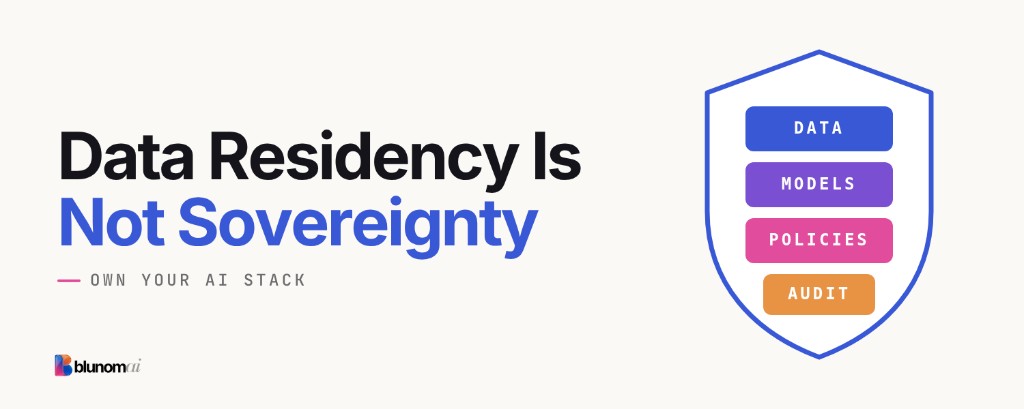
Sovereign AI is the ability to run, govern, and audit your entire AI lifecycle inside boundaries you control. Data residency alone does not deliver it. If your orchestration, policies, evaluations, and audit records live in someone else's control plane, you are renting your AI capability, not owning it. This post explains the difference and what to do about it.
What is sovereign AI?
Sovereign AI means your organization retains meaningful control over four layers at once: where your data lives, which models touch it, what policies govern every agent action, and who holds the audit record. Governments popularized the term. Enterprises need the same idea at their own scale.
Most vendors collapse sovereignty into a checkbox about storage location. That framing is convenient for them and dangerous for you. A bank can satisfy GDPR residency requirements while routing every AI query through an external provider whose decisions it cannot audit. The data passed the audit. The intelligence layer did not.
The distinction matters more in 2026 than it did a year ago. Analysts project a potential 20% shift in cloud infrastructure workloads from global to local providers within a year, driven by geopolitical pressure and new regulation. IT leadership agrees. In a Kyndryl survey of 3,700 IT leaders across 21 countries, 83% said data sovereignty and repatriation regulations became more important in the past 12 months, and 65% had already changed their cloud strategy in response.
Why data residency is not enough
Residency answers one question: where does the data sit? Sovereignty answers a harder set of questions:
Where do the decisions happen? If the routing logic, policy engine, and orchestration layer run in a vendor's cloud, the vendor controls your AI behavior. You control a storage bucket.
Who can change the rules? Vendor-managed sovereignty is not sovereignty. If you operate on their terms, they can change the terms. Pricing, model access, API behavior, and deprecation schedules all sit outside your authority.
Can you prove what happened? Regulators under the EU AI Act and frameworks like NIST AI RMF expect auditability that most organizations cannot yet demonstrate. If your audit trail lives in a third-party system, your compliance posture depends on their export tooling and their retention policy.
Can you leave? Escape velocity is a sovereignty requirement, not a nice-to-have. If switching model providers means rewriting every application, you have lock-in with extra steps.
The test is simple. If your AI vendor disappeared tomorrow, what would you still own? For most enterprises the honest answer is: the data, and nothing else. No workflows. No policies. No evaluation history. No institutional knowledge encoded in the system. That is renting.
Models are becoming a utility. The stack is the asset.
Here is the strategic shift most AI roadmaps miss. Frontier models are converging into a utility. Capability gaps between top providers close in months. Prices fall on a curve. Access is commoditizing the same way compute did.
Nobody builds competitive advantage by choosing an electricity provider. You build it in what you run on the electricity.
The durable assets in enterprise AI sit above the model layer:
Orchestration. The workflows that connect models, tools, data, and humans into repeatable business processes. This is where your operational knowledge gets encoded.
Evaluations. Your evals are your quality bar, expressed as code. An enterprise that owns a rigorous eval suite can swap models in a day and know exactly what improved and what regressed. An enterprise without one is guessing. Evals are also your negotiating leverage. When you can benchmark any model against your actual workloads, no vendor can hold you hostage.
Metadata. Every agent run generates traces: prompts, tool calls, decisions, outcomes, costs, human corrections. This telemetry is the most valuable dataset your company will produce this decade. It captures how your business actually works at a resolution no ERP ever achieved. If that metadata accumulates in a vendor's system, you are donating your operational intelligence to someone else's roadmap.
Your own models, eventually. The endgame of owning evals and metadata is the option to fine-tune or train models on your own operational data. You may never need to. But the enterprises that own their traces and evaluation history will have the choice. The ones that rented everything will not. Optionality is the point.
Own the stack. Treat the model as a socket you plug into it.
What does a sovereign AI control plane actually do?
A sovereign AI control plane is the layer that separates who decides from where things run. It sits between your business and every model, agent, tool, and data source, and it enforces your rules on all of them. In practice it does five jobs:
- Model-agnostic routing. Any model, any cloud, swapped without rewriting applications. This converts model choice from an architecture decision into a configuration decision.
- Policy enforcement on every action. Not periodic review. Governance on every iteration of the agent loop, before actions execute, not after damage is done.
- Deployment flexibility. Multi-tenant for speed, single-tenant for isolation, private VPC when regulation or IP sensitivity demands it. Sovereignty is a spectrum. The architecture should match your regulatory posture, not force one on you.
- Cost authority. Token-level visibility and guardrails, because runaway inference spend is a governance failure, not a finance surprise.
- In-boundary audit. Every prompt, tool call, and decision logged where you control retention, access, and evidence generation.
The pattern is validated at the top of the market. IBM's Sovereign Core launch centers on a customer-operated control plane with in-boundary identity, encryption, and audit evidence. The hyperscalers are racing to answer the same demand. The architecture question for every CIO is no longer whether a control plane is needed. It is who operates it: you, or your vendor.
How do enterprises move from renting AI to owning it?
You do not need to build data centers. Sovereignty is an operating model, not a real estate project. The practical sequence:
Define sovereignty in writing. Architectural control, operational independence, escape velocity. Make these procurement requirements, not aspirations.
Consolidate onto one control plane. Tool sprawl is the enemy of sovereignty. Every point solution is another vendor holding a piece of your operating model.
Instrument everything. Capture traces and metadata from day one, inside your boundary. This data appreciates. Start accumulating it now.
Build your eval suite. Start with your top three workflows. Score every model change against them. This is the single highest-leverage investment in enterprise AI.
Test your exit. Swap a production model on purpose. If it takes more than a day, you have found your lock-in before it found you.
Keep the option to train. Structure your data and metadata so fine-tuning is a future decision, not a future migration.
This is what AI transformation actually means. Not adding a chatbot to a legacy process. Rebuilding the operating model so intelligence is an owned capability, compounding inside your walls, instead of a metered service you rent by the token. The next posts in this series cover governing shadow AI agents and moving agents from pilot to production.
FAQ
What is the difference between data sovereignty and AI sovereignty?
Data sovereignty governs where data is stored and which laws apply to it. AI sovereignty governs the full lifecycle: models, orchestration, policies, evaluations, and audit records. You can have compliant data storage and zero control over your AI systems.
Is a private cloud deployment the same as sovereign AI?
No. Infrastructure location is one layer. If the control plane, policies, and audit trail are vendor-operated, the deployment is private but not sovereign.
Do we need to train our own models to be sovereign?
No. Treat frontier models as interchangeable utilities behind a model-agnostic control plane. Own the orchestration, evals, and metadata. Training your own models becomes an option you hold, not a prerequisite.
Why do evals matter for sovereignty?
Evals make model choice reversible. If you can measure any model against your real workloads, you can switch providers on evidence instead of faith. That is operational independence in practice.
Own your AI. Stop renting it.
Blunom is the Sovereign AI Control Plane built for this exact transition. One platform unifies models, agents, tools, and data under your authority. Model-agnostic orchestration keeps every frontier model on tap without lock-in. The AI Firewall and agentic policy engine enforce governance on every iteration of the agent loop. TokenOps gives your CFO real cost authority instead of a monthly surprise. Every trace, eval, and audit record accumulates inside your boundary, in multi-tenant, single-tenant, or private VPC deployments matched to your regulatory posture.
Your competitors are renting intelligence by the token. The enterprises that win the next decade will own the stack the tokens flow through. Blunom gives you that stack in weeks, not quarters.
See it live at blunom.ai.
Serge Shevchenko, Co-Founder at Blunom Inc. | serge@blunom.ai